

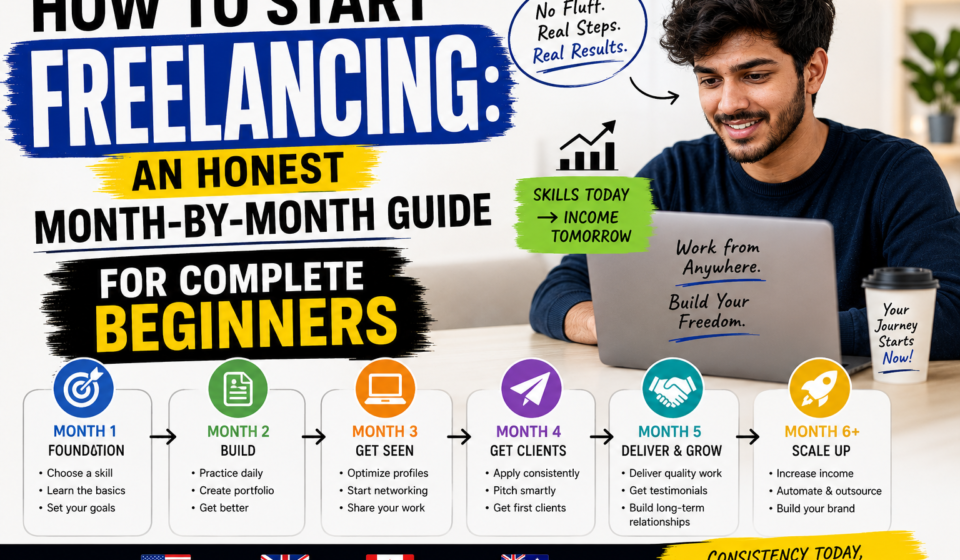
How to Start Freelancing: An Honest Month-by-Month Guide for Complete Beginners
Let me tell you what month 1 of freelancing actually looks like, because almost nobody tells you the truth about it.
You pick a skill. You set up a profile somewhere. You send pitches. You wait.
Most of the pitches get ignored. Some get polite “not right now” replies. Maybe one or two go somewhere and then go nowhere.
You make $0.
You think: maybe this isn’t for me. Maybe I’m not good enough. Maybe the market is too competitive. Maybe I should try something else.
Most people quit here. The people who don’t quit build something real.
I’m not saying this to be motivational. I’m saying it because the gap between “what month 1 actually is” and “what people expect month 1 to be” is the primary reason freelancing fails for people who had a legitimate shot at making it work.
This guide is about the real timeline, the real process, and the specific things that change between month 1 (usually $0) and month 6 (when it starts to feel like a business).
Before You Start One Decision That Changes Everything
Before platforms, before pitches, before any of the tactical stuff: you need to decide what you’re actually selling.
“Freelance writer” is not a service. “Freelance writer who creates blog content for B2B software companies” is a service. The second one is 10 times easier to sell because the buyer can immediately see whether you’re relevant to them and you can demonstrate specific expertise.
The same principle applies to every freelance skill:
“Virtual assistant” is too broad. “Virtual assistant for e-commerce sellers — product listings, customer service, inventory management” is a real offer.
“Graphic designer” is too broad. “Graphic designer for social media content for small service businesses” is a real offer.
“Web developer” is too broad. “WordPress developer specializing in small business websites under $3,000” is a real offer.
The more specific you are, the smaller your potential client pool — but the higher your conversion rate from pitch to client, the clearer the value you’re offering, and the less you compete on price with every other generalist.
Pick your niche before you do anything else.
The Real Month-By-Month Timeline
What follows is an honest account of what building a freelance income actually looks like for most people who make it work. Individual results vary, but the shape of the curve is consistent.
Month 1: Almost certainly $0, or very close.
This is the hardest month. You’re pitching into silence. The pitches that don’t get replies feel personal even when they’re not. Everything takes longer than expected — setting up profiles, writing samples, figuring out how to pitch.
The goal in month 1 is not money. The goal is data. You’re learning what makes a good pitch, which platforms have clients for your niche, what your samples need to show, and how to talk about what you do. That learning has financial value even at $0 in revenue.
Month 2: First money, small amount.
Most people who stick through month 1 make their first payment in month 2. It’s often somewhere between $50 and $200. It feels both underwhelming and like proof that this might actually work.
The psychological shift that happens with the first payment — no matter how small — is significant. It’s confirmation that someone will pay real money for what you do. That changes how you approach month 3.
Month 3: $150-$400 range for most people who are pitching consistently.
By month 3, you’ve gotten enough feedback from pitches and clients to know what works. Your pitches are getting better. You may have a repeat client from month 2. The income is real but not yet meaningful.
Month 4-5: $300-$700 range. First referrals.
Referrals are when freelancing starts to feel different. A client recommends you to someone they know. Inbound inquiry comes from somewhere you didn’t pitch. Both of these signal that your work is good enough that clients want to tell people about it — which is the whole foundation of a sustainable freelance business.
Month 6: $500-$1,000+ range for people who have executed well.
By month 6, most successful freelancers have 2-4 ongoing clients, some repeat business, and a pipeline of new leads that requires less cold pitching because referrals and reputation are starting to work. The income isn’t replacing a salary yet but it’s real money for real work.
Month 12+: The range widens significantly based on niche, rates, and how much time you’re putting in. Some people are at $1,500/month. Some are at $5,000/month. The difference is usually specialization, rates, and whether they’re building the business or just doing client work.
The Portfolio Problem (And How to Solve It)
Before you can get clients, you need samples. Before you have clients, how do you get samples?
This is the chicken-and-egg problem that stops most beginners. The answer is straightforward but requires front-loading some work.
Create samples specifically for the clients you want to attract.
If you want to write for personal finance blogs, write 3 articles on personal finance topics and present them as samples. If you want to design social media graphics for restaurants, create a mock social media package for an imaginary restaurant. If you want to do data entry and virtual assistant work for e-commerce sellers, document a system or process as if you were working for a client.
You don’t need clients to create samples. You need to know what clients in your niche want and create something that demonstrates you can provide it.
Three strong samples relevant to your niche will outperform 10 generic samples every time.
Where to host them: Contently (for writers), Behance or Dribbble (for designers), a basic LinkedIn profile with samples attached, or simply a Google Drive folder with a shareable link. You do not need a website to start.
Writing Pitches That Actually Get Replies
The most common reason pitches don’t work isn’t that the freelancer isn’t good enough. It’s that the pitch is about the freelancer, not the client.
Bad pitch (talks about you):
“Hi, I’m a freelance writer with 2 years of experience specializing in content marketing. I’m skilled in SEO and can write on a range of topics. Please see my portfolio and let me know if you’re interested in working together.”
Why it doesn’t work: the client has to do all the work of figuring out why you’re relevant to them. They won’t. They have 50 other pitches to read.
Better pitch (talks about them):
“Hi [Name] I noticed your blog has been quiet since March and your competitors in [specific niche] are publishing weekly content that’s ranking for keywords you’re not showing up for. I write specifically for [their industry] and have a specific article idea I think would perform well for your audience. Here’s a quick outline: [3 bullet points]. Here’s my most relevant sample: [link]. Would it make sense to have a quick call this week?”
Why it works: you’ve shown you know who they are, you’ve identified a specific gap, you’ve given them something concrete to react to, and you’ve made the next step clear.
The research required for a good pitch: 10-15 minutes per company. Look at their website, their content, their competitors, and think about one specific thing you could do that would help them.
This approach means sending fewer pitches but getting significantly more replies from the pitches you send.
Which Platform to Start With
Upwork, LinkedIn, direct outreach, and various freelance-specific platforms all work. They work differently and for different types of freelancers.
Upwork: highest volume of posted jobs, highest competition. The platform has an established review system that heavily favors sellers with history which you don’t have at first. The strategy is to take 2-3 smaller projects at below-market rates to build reviews, then raise your rates. This is not ideal but it’s the fastest way to establish credibility on the platform.
LinkedIn: underused by freelancers and underestimated. Many small and medium businesses hire directly from LinkedIn without posting on freelance platforms. Optimizing your profile to clearly state your service and who you help, then connecting with people in your target client category and offering value before pitching, works well but takes longer to produce results.
Direct cold email to businesses in your niche: highest effort, often highest quality clients. Research specific companies that fit your ideal client profile, find the decision maker’s email, send a personalized pitch. Conversion rate is low — maybe 3-8% — but the clients you land this way tend to have longer engagements and better budgets than platform-sourced clients.
Start with one. Get comfortable with the approach before adding others.
Setting Your Rate (Without Undervaluing or Pricing Yourself Out)
Rates are one of the most anxiety-inducing parts of starting out. Here’s a practical framework.
Find out what established freelancers in your niche charge. This is usually findable through online communities for your freelance type, by looking at what services are listed for on platforms, or simply by asking. You want to know the range, not just one number.
Start at the lower end of the range for your first few clients but not dramatically below it. Extremely low rates attract clients who are more difficult to work with, more demanding, and less likely to leave good reviews or refer you. The client who pays $300 for a project that should cost $400 is often more work than the client who pays $400.
Raise rates after you have your first 3-5 positive client experiences. A 20-30% rate increase after proving your work is standard. Most existing clients will stay. Some won’t and the new clients you attract at the higher rate will be higher quality.
Don’t price hourly if you can avoid it. Project-based pricing or retainers are better for your income and better for the client relationship. Hourly pricing creates a situation where getting faster at your job reduces your income.
The Mindset Shift That Separates People Who Build Something From People Who Quit
Somewhere around month 3 or 4, something changes for freelancers who make it work.
They stop thinking “I hope this client hires me” and start thinking “I’m evaluating whether this client is a good fit for my business.”
This sounds like arrogance if you’re in month 1 with $0 in the bank. But it’s actually just recognizing the reality: you’re not an employee hoping for approval. You’re a business owner making decisions about which clients to take and which to pass on.
The practical implication is real: learning to screen for difficult clients early late payers, unclear briefs, disrespectful communication, scope creep and walk away from them saves significant time and psychological energy that’s better spent on good clients and new business development.
The clients you turn down make room for better ones. This takes experience to recognize but it’s one of the most important things to internalize.
Frequently Asked Questions
Q: How many pitches should I send per week?
At minimum 5-10 quality, researched pitches per week in the first three months. Volume matters early because you’re running experiments to find out what works. Quality matters more than quantity but at the beginning you need enough data points to learn what’s working.
Q: Do I need to register a business before I start?
No. You can operate as a sole proprietor without formal registration in most countries. Once you’re earning consistently, consult a local accountant or tax professional about the right structure. The freelancing can and should start before the administrative overhead.
Q: What if I face a client who refuses to pay?
This is why contracts and upfront deposits matter. For new clients, request 50% payment before starting work. Use a written contract free templates are available through Bonsai, HelloSign, and similar platforms. If someone refuses to pay despite a contract, you have recourse. If there’s no contract, you have significantly less.
Q: What’s a realistic income target for 12 months in?
For someone freelancing alongside a day job (roughly 10-15 hours per week available): $800-$2,000/month is a reasonable target after 12 months of consistent effort. For someone freelancing full-time from the start: income is highly variable in year one but $3,000-$5,000/month by month 12 is achievable with the right niche and approach.