

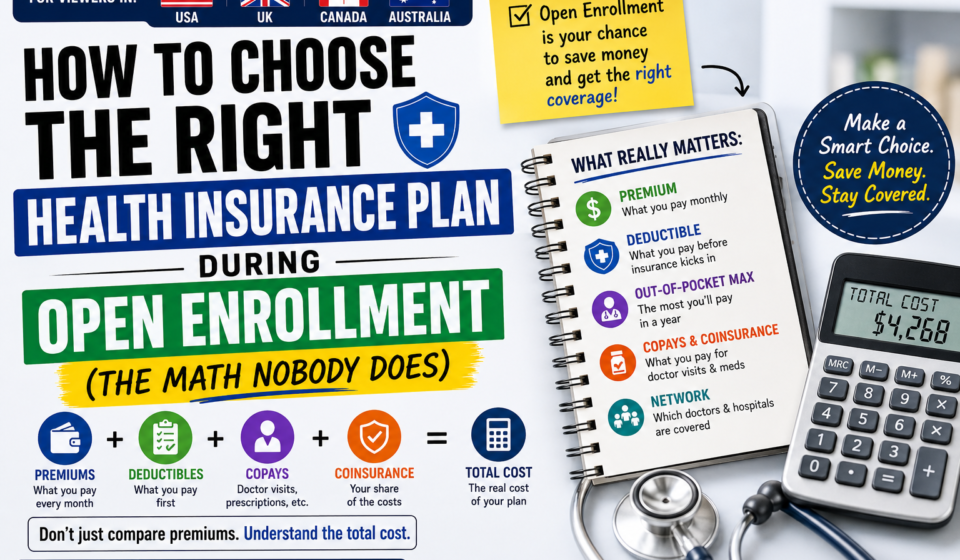
How to Choose the Right Health Insurance Plan During Open Enrollment (The Math Nobody Does)
Last year I chose the health insurance plan with the second-lowest premium during open enrollment at my company. I saved $47/month compared to the plan I almost picked.
Then I used my insurance. Twice an ER visit and an outpatient procedure. Nothing catastrophic. Just two things that happen.
My actual out-of-pocket costs on the plan I chose: $5,670.
My estimated out-of-pocket costs on the plan I’d passed on: approximately $2,800.
My premium savings from the “cheaper” plan: $564 for the year.
Net cost of my decision: I paid $2,306 more than I would have on the plan I thought was more expensive.
This is the open enrollment mistake that most people make. The premium is the most visible number. It’s also only one component of your actual annual cost. If you’re choosing your health insurance based on premium alone, you may be choosing the most expensive plan in your specific situation without knowing it.
The Math You Should Actually Do Before Open Enrollment Closes
Most people compare health insurance plans by looking at premiums and perhaps glancing at deductibles. The actual total cost calculation is more involved but not complicated — it takes about 30 minutes and is worth doing every single year.
Step 1: Estimate your healthcare usage for the coming year.
Be realistic. How many primary care visits? Any anticipated specialist appointments? Any procedures or imaging you’ve been putting off? Ongoing prescriptions? Family members who regularly use healthcare?
You’re not predicting the future. You’re making a reasonable estimate based on your history and your planned care.
Step 2: For each plan option, calculate the estimated annual cost.
Annual premium: monthly premium × 12.
Estimated out-of-pocket for expected usage: this requires looking at each plan’s copays, deductibles, and coinsurance. Walk through your expected visits and calculate what each would cost under each plan.
This sounds tedious. For most people with predictable healthcare usage, you can estimate it reasonably in 15-20 minutes per plan.
Step 3: Add annual premium + estimated out-of-pocket = estimated total annual cost for each plan.
Step 4: Calculate the worst-case scenario for each plan.
Annual premium + out-of-pocket maximum = maximum possible annual cost.
If you had a major health event — hospitalization, surgery, serious illness — what’s the most you’d pay under each plan? This is your downside protection comparison.
Step 5: Compare across plans.
The right plan is the one with the lowest expected total annual cost given your situation, balanced against the worst-case protection you’re comfortable with.
Why Low Premiums Don’t Mean Low Cost
High-deductible plans have lower premiums and higher deductibles. This is the trade-off.
For people who rarely use healthcare young and healthy, minimal prescriptions, no ongoing conditions — the math often favors the high-deductible plan. You pay less monthly, and in the years where you use little healthcare, you come out ahead.
For people who use healthcare regularly chronic conditions, regular specialist visits, ongoing medications, families with children — the math often favors a lower-deductible plan even at higher premiums. The lower deductible means insurance kicks in faster, reducing your out-of-pocket costs on the care you actually receive.
The problem is that most people make this decision based on how they feel about their health rather than based on actual numbers. “I’m healthy, I’ll pick the cheaper plan” is a common and sometimes expensive assumption.
Do the calculation. It tells you which plan is cheaper for your specific situation, not which looks cheaper at first glance.
The HSA Advantage Why High-Deductible Plans Are Sometimes Better Than They Appear
High-deductible health plans are HSA-eligible. This changes the calculation significantly.
An HSA Health Savings Account is a tax-advantaged account where contributions reduce your taxable income, growth is tax-free, and withdrawals for qualified medical expenses are tax-free. It’s triple-tax-advantaged, which makes it one of the most powerful savings vehicles available.
Unlike FSAs (Flexible Spending Accounts), HSA funds don’t expire at year end. They roll over indefinitely. They can be invested. After age 65, they function like a traditional IRA withdrawals for any purpose are taxed as ordinary income.
The 2026 contribution limits: $4,300 for individual coverage, $8,550 for family coverage.
If you choose an HDHP, maximizing your HSA contribution partially offsets the higher deductible through tax savings. At a 22% marginal tax rate, a $4,300 HSA contribution saves $946 in federal taxes. That’s real money that should be factored into your total cost comparison between plan types.
Practical approach: if your employer offers both HDHP and non-HDHP options, run the full calculation including HSA tax savings before dismissing the high-deductible plan as obviously worse.
Questions to Ask About Each Plan Before Deciding
Is my current doctor in-network? Don’t assume. Call your insurance company with your doctor’s NPI number and confirm for the specific plan you’re considering.
Are my current prescriptions covered, and at what tier? Check each plan’s formulary for drugs you take regularly. A medication that’s Tier 1 in one plan might be Tier 3 in another, with significantly different cost-sharing.
What’s the out-of-network coverage? Some plans have no out-of-network coverage (EPO, HMO). Others cover out-of-network at higher cost-sharing (PPO). If you have existing specialist relationships outside your area, this matters.
Does the plan cover mental health and substance use treatment at parity with medical coverage? Federal law requires parity, but plan designs vary in how accessible these benefits are in practice. If you or a family member uses these services, ask specifically.
What’s the prior authorization process for specialty care or procedures? Some plans require prior approval for specific services. Understanding this before you need it prevents unexpected denials.
The FSA vs. HSA Decision
If your employer offers both an FSA (Flexible Spending Account) and you’re on an HDHP, you may be eligible for a Limited Purpose FSA which covers dental and vision only — while still contributing to an HSA.
If you’re on a non-HDHP, you may be eligible for a Healthcare FSA. Key differences from HSA:
FSA funds expire at year end (with a small grace period or limited rollover in some plans). Use it or lose it.
FSA contributions are not investable.
FSA contribution limit for 2026: $3,200.
FSA is funded pre-tax, reducing your taxable income. Worth using if you have predictable healthcare expenses you’d incur anyway — dental, vision, copays, prescriptions.
Making the Decision
After doing the calculation, you’ll have:
Estimated total annual cost for each plan based on expected usage.
Worst-case annual cost for each plan.
An understanding of what you’re covered for in each plan.
The choice involves two factors: which plan is cheaper in the expected scenario, and how much risk you’re comfortable taking on the worst-case scenario.
High-deductible plans are often cheaper in the expected scenario for healthy people. They expose you to higher costs in a bad year. If you have the cash reserves to handle the deductible without financial stress, this risk is manageable. If a $3,000 unexpected medical bill would seriously strain your finances, lower-deductible coverage at higher premiums may be the more rational choice even if it costs more in the average year.
Health insurance is also an insurance product it protects against downside scenarios, not just expected costs. Factor in your financial resilience when making the final call.
Frequently Asked Questions
Q: Can I change my plan outside of open enrollment?
Only during a Special Enrollment Period triggered by a qualifying life event: losing other coverage, getting married, having a child, moving to a new coverage area. Outside of these events, you’re locked into your plan until the next open enrollment.
Q: What happens if I miss open enrollment?
If you miss your employer’s open enrollment window, you’re typically stuck with whatever plan you currently have (or no plan if you were newly eligible). If you have no coverage and miss marketplace open enrollment, you must wait for the next enrollment period or a qualifying event. This is a genuine risk set a reminder for open enrollment dates.
Q: Is it worth getting supplemental insurance like critical illness or accident policies?
These products fill specific gaps but are often oversold. Evaluate based on your specific situation: if your out-of-pocket maximum is very high and you have limited savings to cover it, critical illness coverage can make sense. For most people with reasonable emergency savings and a standard health plan, the additional premiums often exceed the expected benefit.
Q: How do I handle healthcare costs between jobs?
Your options: COBRA (expensive but continuous coverage), marketplace plans (often more affordable than COBRA for people between jobs who have income between 100-400% of the federal poverty level), or if income is very low, Medicaid. Apply for marketplace coverage within 60 days of losing job-based coverage to avoid a gap.