

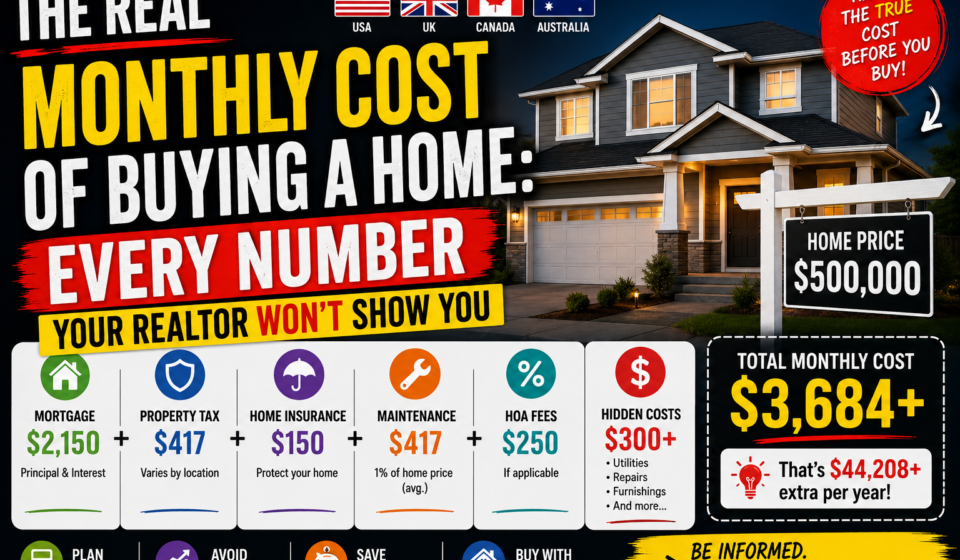
The Real Monthly Cost of Buying a Home: Every Number Your Realtor Won’t Show You
My realtor was a pleasant person who genuinely wanted to help me buy a house. She also consistently referenced one number when talking about affordability: the mortgage payment.
“Your payment will be around $1,480 a month,” she’d say. “Very manageable.”
She wasn’t wrong about the mortgage payment. She was significantly wrong about what I’d actually pay to own that house every month.
Here’s what my actual monthly housing cost looked like in year one:
Mortgage (principal + interest): $1,480
Property taxes: $387
Homeowner’s insurance: $134
PMI (I put 8% down): $198
HOA fees: $245
Average maintenance (I budget $250/month): $250
Total before anything breaks: $2,694/month.
My rent before buying: $1,650/month.
The gap I thought I was closing: $1,480 (mortgage) minus $1,650 (rent) = $170. Basically a wash.
The gap I was actually closing: $2,694 minus $1,650 = $1,044/month more than renting.
I knew this going in because I built a spreadsheet before closing. A lot of first-time buyers don’t. This article is the spreadsheet.
The Mortgage Payment Is Just the Beginning
The mortgage payment principal and interest is the number that appears in online calculators and gets quoted by realtors and lenders because it’s the number their products produce.
But owning a home involves costs that are invisible in the mortgage conversation and add up to hundreds of dollars per month that buyers don’t see until they’re already committed.
Let me walk through each one.
Property Taxes
Property taxes are paid to local governments annually based on the assessed value of your property. In the US, they vary enormously by state and county from under 0.4% of home value annually in some Southern states to over 2.4% in parts of New Jersey, Illinois, and New York.
The national average is approximately 1.1% annually.
On a $300,000 home at the national average: $3,300/year = $275/month.
What many buyers don’t realize: property taxes typically reassess when a property is sold, often resetting to the current market value. The previous owner’s tax bill which may be based on an older, lower assessment is not what you’ll pay. Check the county assessor’s website for the specific property you’re considering and look up its current tax bill, not the previous owner’s.
Also worth knowing: property taxes increase over time as local governments adjust rates and reassessments occur. Budgeting at the current rate without assuming any increase is slightly optimistic.
Homeowner’s Insurance
Mortgage lenders require homeowner’s insurance as a condition of the loan. The policy covers the structure against fire, storm, and other covered events, plus liability protection.
Typical range: $100-$200/month for a standard policy on a median-priced home.
What significantly changes this number: location risk. Homes in hurricane zones, flood plains, wildfire risk areas, or tornado-prone regions can have dramatically higher insurance premiums — sometimes 3-5x the national average. Some areas have seen insurers exit the market entirely, leaving homeowners with limited and expensive options.
Before falling in love with a property, get an insurance quote for that specific property in that specific location. Don’t assume national averages apply.
Private Mortgage Insurance (PMI)
If you put less than 20% down, your lender requires PMI insurance that protects the lender (not you) if you default on the loan.
Typical cost: 0.5% to 1.5% of the loan amount annually.
On a $270,000 loan (90% of $300,000 purchase price) at 1%: $225/month.
PMI eventually goes away once you build 20% equity either through payments or appreciation. But here’s what most buyers don’t calculate: in the early years of a 30-year mortgage, the overwhelming majority of each payment goes to interest, not principal. Building equity through payments alone is slow.
At a 6.8% interest rate on a $270,000 loan, your first payment includes roughly $153/month in principal reduction and $1,530 in interest. You’re paying $225/month for PMI and building $153/month in equity. The PMI costs more per month than the equity you’re building in that same month.
HOA Fees
Homeowners Associations and their fees are common in condos, townhomes, and many newer single-family subdivisions.
National average: $200-$400/month. Some communities, particularly luxury developments or high-amenity communities, charge $600-$2,000+/month.
What many buyers miss: HOA fees are not fixed. They’re voted on by the HOA board and can be raised. Special assessments — one-time charges for major repairs to common areas, roof replacements on shared buildings, pool renovations — can appear with relatively short notice and run into thousands of dollars.
Before buying in an HOA community: review the HOA’s meeting minutes for the last two years, the reserve fund balance, and whether any special assessments are being discussed. A well-funded HOA with healthy reserves is significantly less risk than one that’s been deferring maintenance.
Maintenance and Repairs
This is the category most new homeowners underestimate most severely.
The commonly cited rule: budget 1% of home value annually for maintenance and repairs. On a $300,000 home: $3,000/year = $250/month.
Some financial advisors cite 2% for older homes or higher cost-of-living areas.
What maintenance looks like in practice: most years you’ll spend less than 1%. Some years significantly more. A roof replacement runs $8,000-$20,000 depending on size and materials. HVAC replacement: $5,000-$12,000. Foundation work: $5,000-$50,000 for serious issues. Water heater: $800-$2,000. Major appliance replacements: $500-$2,500 each.
These expenses don’t arrive on a schedule. They arrive when systems reach end of life or when something breaks, which is often the worst possible time financially.
The 1% rule isn’t a guarantee it’s a planning tool. The key is having a separate home maintenance fund that you contribute to monthly and don’t touch for non-home expenses. When the HVAC dies at 3 PM on a July Friday, having the money matters more than having the right annual average.
The Upfront Costs Beyond the Down Payment
Closing costs are the most commonly underestimated upfront expense in homebuying. Most people know they need a down payment. Far fewer have a clear picture of what closing costs actually total.
Typical range: 2-5% of the purchase price.
On a $300,000 home: $6,000-$15,000.
What closing costs include: loan origination fees, appraisal fee ($500-$800), title search and title insurance ($1,000-$2,500), attorney fees where applicable ($500-$1,500), prepaid interest (the days between closing and your first payment), property tax escrow setup, homeowner’s insurance escrow, recording fees, and various lender fees.
These costs are disclosed in the Loan Estimate your lender provides within three days of application, and again in the Closing Disclosure provided three days before closing. Read both carefully and ask questions about anything that appears or changes between the two documents.
Beyond closing costs:
Immediate move-in costs: even homes with clean inspections often have things the buyer wants to address a coat of paint, new locks, minor updates, items identified in inspection that were negotiated off the price rather than repaired.
Moving: $800-$5,000+ depending on distance, volume, and whether you hire movers.
Furnishing: buyers moving from smaller spaces commonly need additional furniture for a larger home. This can be significant.
A buyer who has exactly enough for the down payment and closing costs is not financially ready to close. A realistic additional buffer of $10,000-$20,000 for a median-priced home provides the runway for the first year of homeownership without financial stress.
The Break-Even Timeline How Long Before Buying Beats Renting?
Buying almost always beats renting eventually. The question is how many years that takes, and whether your plans match that timeline.
The break-even calculation accounts for: transaction costs on purchase and eventual sale (realtor fees total 5-6% of sale price at sale), equity built through principal payments, property appreciation, the alternative investment return on your down payment, and tax advantages of ownership.
A rough guideline from most real estate economists: break-even versus renting in an average US market happens between 4-7 years. In high-cost markets New York, San Francisco, Seattle break-even can take 8-12 years.
If you expect to move in 3-4 years, the financial case for buying is weak in most markets regardless of what any realtor tells you.
Calculating your specific break-even: the New York Times Rent vs. Buy calculator is excellent — it accounts for your specific down payment, mortgage rate, expected appreciation, and investment alternatives, and gives you a year-by-year comparison.
Signs You’re Financially Ready to Buy
You have 20% down and a separate emergency fund. Not “I have 20% and some of it is my emergency fund.” Twenty percent for the purchase and separate emergency savings of 3-6 months of expenses.
Your total monthly housing cost using the real numbers from the sections above is at or below 28% of your gross monthly income.
You’ve verified the actual property tax bill on the specific home you’re considering. Not an estimate. The actual current bill from the county assessor.
You’ve gotten homeowner’s insurance quotes for the specific property and location before making an offer.
You’ve read the full home inspection report, not just your realtor’s summary of it. You’ve Googled the electrical panel brand (Federal Pacific and Zinsco panels have known safety concerns worth knowing about before buying).
You plan to stay for at least 5-7 years.
You’ve run the full monthly cost using all the numbers above, not just the mortgage payment, and you’re comfortable with that number.
Frequently Asked Questions
Q: Is it always better to put 20% down?
Financially, yes it eliminates PMI, gets you a better interest rate, and provides equity cushion against market fluctuations. Practically, waiting to save 20% means renting longer, which in rising markets can mean buying at higher prices. There’s no universal right answer, but the full-cost calculation above should be done with whatever down payment you’re considering.
Q: How do I find out the actual property tax bill?
Search “[County name] property tax records” or “[County name] assessor.” Most counties have online property search tools where you can look up any address. The current tax bill for the home you’re considering is public information.
Q: What’s PMI and when does it go away?
PMI is private mortgage insurance required when your down payment is less than 20%. It goes away when you reach 20% equity — through payments, through appreciation, or through a combination. Under federal law (Homeowners Protection Act), you can request removal of PMI when you reach 20% equity, and lenders must automatically cancel it when you reach 22% equity based on the original purchase price and payment schedule.
Q: How do I evaluate whether an HOA is well-managed?
Request the following before making an offer: the HOA’s financial statements for the last 2 years, meeting minutes for the last year, the reserve fund study, and any information about pending or discussed special assessments. A healthy HOA has reserve funds covering at least 70-80% of anticipated major expenses. An underfunded HOA with deferred maintenance is a financial risk that doesn’t appear in the listing.