
The Credit Card Minimum Payment Trap: What It Actually Costs You (With Real Math)
There’s a box on the back of most American credit card statements that almost nobody reads.
It’s required by law. It’s been there since 2010. And if more people actually looked at it, the credit card industry would look very different.
The box shows two things: how long it will take to pay off your current balance if you only make minimum payments, and the total amount you’ll pay over that time.
I looked at mine for the first time about two years ago. I had a $2,800 balance on a card at 24% APR. The minimum payment was $56 a month, and I’d been making it faithfully for almost a year, never missing, feeling responsible.
The box said: 23 years. Total paid: $7,414.
I sat with that for a long time. I was 28. I would be 51 years old still paying off something I’d borrowed at 28 and I’d pay $7,414 for the privilege of borrowing $2,800.
That was the day I stopped paying minimums on anything, ever.
Why Minimum Payments Are Designed to Keep You Paying Forever
This isn’t cynical speculation it’s how the product works.
Credit card companies make money from interest. The longer your balance takes to pay off, the more interest they collect. Minimum payments are calculated specifically to keep that process running as long as possible while staying just above the threshold of what feels manageable to you.
Before 2003, minimum payments on many cards were as low as 2% of the balance. After regulatory pressure, most issuers raised minimums slightly but the new structure still extends repayment timelines significantly.
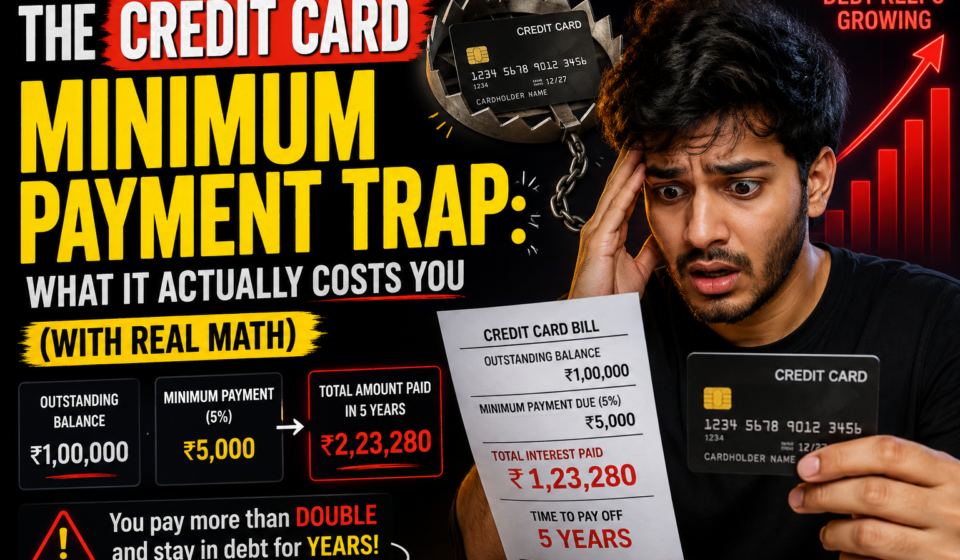
Here’s how the math works. On a $3,000 balance at 22% APR, a typical minimum payment might be about $75/month. Of that $75, roughly $55 is interest. Only $20 is reducing the actual balance you owe. At that rate, you’re moving slowly enough that it takes over a decade to clear the debt.
The payment feels like progress. Mathematically, it barely is.
The Numbers Across Different Balance Sizes
Let me show you the real cost at several common balance amounts. These use 22% APR, close to the current US average for non-promotional credit card rates.
$1,000 balance, minimum payments only:
Time to pay off: 7 years, 10 months
Total paid: $2,390
Interest paid: $1,390
$1,000 balance, paying $50/month fixed:
Time to pay off: 2 years, 2 months
Total paid: $1,286
Interest paid: $286
Savings: $1,104 and 5+ years
$3,000 balance, minimum payments only:
Time to pay off: 15 years, 9 months
Total paid: $7,162
Interest paid: $4,162
$3,000 balance, paying $150/month fixed:
Time to pay off: 2 years, 3 months
Total paid: $3,970
Interest paid: $970
Savings: $3,192 and 13 years
$5,000 balance, minimum payments only:
Time to pay off: 22 years, 6 months
Total paid: $14,873
Interest paid: $9,873
$5,000 balance, paying $200/month fixed:
Time to pay off: 3 years, 1 month
Total paid: $7,407
Interest paid: $2,407
Savings: $7,466 and 19 years
The savings from fixed payments over minimum payments are not small. They are life-changing for the same debt, the same interest rate, just a different monthly payment amount.
The Mistake I Made That Made Everything Worse
Here’s the specific error I made that compounded the minimum payment problem.
While I was carrying credit card debt at 24% interest, I had money in a savings account earning approximately 0.05%. Not much a traditional savings account earning essentially nothing.
My thinking: I should keep the savings as a safety net. Pay the card down gradually. Keep the accounts separate.
The actual math: every dollar sitting in that savings account was costing me roughly 24 cents per year in net terms. I was paying 24% interest on debt while earning 0.05% on savings of a similar size.
The correct move the one that felt wrong emotionally was to use savings to pay off the high-interest debt, then rebuild savings over a few months. The emotional discomfort of a lower savings balance was costing me real money every month.
There’s one exception worth noting: keep a small emergency buffer enough to cover one month of basic expenses before paying down debt aggressively. Without any cushion, one unexpected expense goes back on the card and undoes your progress. The buffer prevents the cycle from resetting.
But beyond that small cushion, carrying high-interest debt while hoarding low-yield savings is a losing equation every month.
If You Have Multiple Debts The Right Order to Pay Them
Two common strategies for paying down multiple debts are the debt avalanche and the debt snowball. They’re different in approach and both work but for different reasons.
The debt avalanche: make minimum payments on everything, then put every extra dollar toward the debt with the highest interest rate. Once that’s gone, move to the next highest. Mathematically, this is optimal — it minimizes total interest paid.
The debt snowball: make minimum payments on everything, then put every extra dollar toward the smallest balance. Once that’s eliminated, roll that payment to the next smallest. This isn’t mathematically optimal but it produces psychological wins — clearing a debt completely gives a sense of progress that keeps people going.
Studies on debt repayment consistently find that people who use the snowball method actually pay off more debt in practice than people who use the avalanche, because they stick with it longer. The mathematically inferior strategy produces better real-world results for many people because it keeps them motivated.
My practical recommendation: if you have any debt above 20% interest, prioritize that first regardless of balance size — the interest cost is high enough that it overrides the psychological argument. For everything below that rate, use whichever method you’ll actually maintain for the 12-24 months it takes to work.
The Balance Transfer Option When It Makes Sense
Many credit cards offer promotional 0% APR periods on balance transfers, typically 12 to 21 months. Moving high-interest debt to a 0% card and paying it down aggressively during the promotional period can save significant interest.
The catch: there’s usually a balance transfer fee of 3-5% of the amount transferred. On a $3,000 transfer at 3%: $90. Compare that to the interest you’d pay at 22% over the promotional period and the math usually still favors the transfer.
The risk: if you don’t pay the balance in full before the promotional period ends, the remaining balance is typically subject to a high interest rate sometimes higher than what you were paying before. Balance transfers require discipline to execute correctly.
Also worth knowing: applying for a new credit card involves a hard inquiry on your credit report, which temporarily lowers your score slightly. This usually recovers within a few months and the long-term benefit of eliminating high-interest debt is worth it.
The Real Opportunity Cost
The final number I think about when I think about credit card debt:
$200 a month paid to credit card interest for 20 years = $48,000 paid to a credit card company, zero wealth built.
$200 a month invested in a broad index fund for 20 years at historical average returns = approximately $147,000 in wealth built.
That’s not $200 either way. That’s a $147,000 swing for the same monthly commitment.
This is why high-interest debt is the most financially damaging thing most people carry. Not because debt is morally wrong — but because the guaranteed return from eliminating 22% interest exceeds any realistic investment return available to regular people.
Pay it down. Then invest. The order matters more than most people realize.
What to Do Starting This Week
Pull up your credit card statements. Find the box showing your payoff timeline at minimum payments. Actually read it.
Then calculate how much of each minimum payment is interest versus principal. (Balance × annual rate ÷ 12 = monthly interest charge.) See how little of each payment is actually reducing what you owe.
If you have a savings account earning less than 3-4%, evaluate whether some of those funds would be better deployed against high-interest debt.
Pick a fixed payment amount — anything meaningfully above the minimum — and set it up as an automatic payment. Not a manual decision each month. Automatic. Remove the decision and remove the opportunity to pay minimums “just this month.”
The path out of the minimum payment trap isn’t complicated. It’s uncomfortable in the short term and dramatically better in the long term. That’s almost exactly the description of every good financial decision.
Frequently Asked Questions
Q: What if I genuinely can’t afford more than the minimum right now?
Even $10 or $20 above the minimum has a meaningful impact on total interest paid. Start where you can and increase as your situation allows. The goal is moving in the right direction, not perfection.
Q: Will paying off credit card debt hurt my credit score?
No — paying down revolving debt improves your credit utilization ratio, which typically raises your score. The only credit score impact comes from closing a card after paying it off, which can affect your available credit.
Q: Should I stop investing to pay off credit card debt faster?
Keep contributing enough to your employer’s 401k to get the full match — that’s a guaranteed 50-100% return that beats even high-interest debt. Beyond the match, credit card debt above 10% typically should be prioritized over additional investing.
Q: How do I find out the exact payoff timeline for my specific situation?
Your monthly statement should have this information by law. You can also use the Consumer Financial Protection Bureau’s credit card repayment calculator at consumerfinance.gov — enter your balance, rate, and payment amount to see the exact timeline and total cost.