
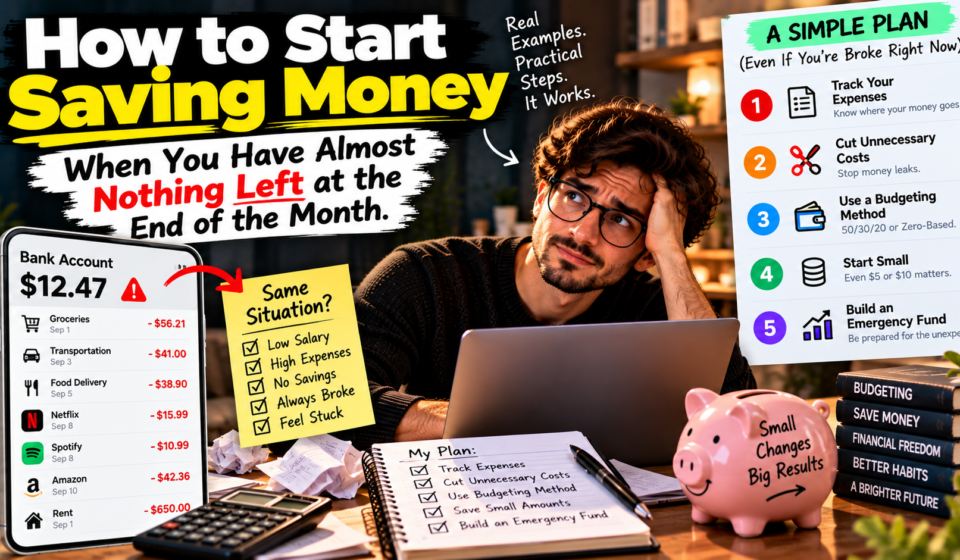
How to Start Saving Money When You Have Almost Nothing Left at the End of the Month
I want to start with something that most personal finance writers skip over.
Saving money is significantly harder when you don’t have much of it.
That’s not an excuse. That’s just true. And I think a lot of financial advice fails people because it’s written by people who forgot what it actually feels like to have $43 in your account five days before payday, trying to decide whether to fill up the gas tank or buy groceries.
I’ve been there. A lot of people have. And the standard advice “automate 20% of your income,” “build a 6-month emergency fund,” “max out your 401k” all of it is technically correct and completely useless when you’re starting from nothing.
This article is not for the version of you that earns more someday. It’s for you right now.
First, Let’s Talk About Why It Feels Impossible
There’s a specific kind of exhaustion that comes with being broke. Not just physical tiredness but the mental weight of constantly calculating. Can I afford this? What happens if the car breaks down? What if I get sick?
Psychologists actually have a name for this: scarcity mindset. And research from Harvard and Princeton has shown that financial stress literally reduces cognitive capacity not because people are less intelligent, but because so much mental bandwidth is consumed by money worries that less is available for long-term planning.
In other words: being financially stressed makes it harder to think clearly about money. Which makes the stress worse. Which makes it harder to think clearly. It’s a cycle.
I’m not saying this to let anyone off the hook. I’m saying it because understanding why saving feels so hard is the first step to actually doing it. You’re not failing because you’re bad with money. You’re struggling because the system is genuinely difficult to break out of when you’re inside it.
The good news: the cycle has entry points. And the first one is smaller than you think.
Forget 20%. Start With $10.
Every savings article will tell you to save 10-20% of your income. If you earn $2,500/month, that’s $250-$500 you’re supposed to set aside.
If that’s realistic for you right now, great. Do it.
But if $250 feels impossible if the idea of setting that aside makes you genuinely anxious because you know you’ll need it for something then trying to save $250 and failing is worse than saving $10 and succeeding.
Here’s what I actually did when I started from nearly nothing: I set up a $25 automatic transfer to a separate savings account on the same day my paycheck hit.
Not $250. Not 10%. $25.
It was small enough that it didn’t feel like sacrifice. My day-to-day life didn’t change. But after 30 days, I had $25 more than zero. After 60 days, $50. After a year, with gradual increases, I had real money in that account for the first time in my adult life.
The amount wasn’t the point at first. The habit was the point.
Think about it this way: the most important thing about your first savings habit isn’t how much you save. It’s that you keep doing it. A $25 habit you maintain for a year beats a $300 habit you quit after two months every single time.
Start where you are. Not where you think you should be.
The One Thing That Separates People Who Save From People Who Don’t
Automation.
I cannot say this strongly enough. If you are manually deciding to transfer money to savings each month, you will eventually stop doing it. Not because you’re undisciplined but because life happens. An unexpected expense comes up. You’re tired and just don’t feel like dealing with it. You tell yourself you’ll do it next week.
The people who consistently save are not more disciplined than the people who don’t. They’ve just removed the decision from the equation.
Set up an automatic transfer even if it’s $15 or $25 that fires the morning after your payday. Every. Single. Month. You never see the money. It just moves.
The account it moves to should be at a different bank than your main checking account. This sounds like an unnecessary hassle, and that’s exactly the point. If your savings are in the same app as your spending account, it’s too easy to move money back. If they’re at a different institution, you have to actively log in, navigate a different interface, and initiate a transfer — enough friction that you won’t do it casually.
Set it up once. Then forget it exists.
Where Is Your Money Actually Going? (This Part Might Sting a Little)
Before you can save more, you need to know where your current money is going.
Not estimates. Not what you think. Actual numbers.
Pull up your bank statement or payment app (Google Pay, Venmo, whatever you use) for the last 30 days. Go through every single transaction. Write them into three categories:
Fixed costs — things that are the same amount every month. Rent, car payment, phone bill, subscriptions, loan payments. These are locked in and hard to change quickly.
Variable needs — things you need but the amount varies. Groceries, gas, utilities, medications.
Variable wants — things that are choices. Restaurants, food delivery, entertainment, shopping, coffee runs, anything you bought on impulse.
Now add up each category. Just look at the numbers without judging yourself.
Most people find two things that surprise them.
First: the “variable wants” category is almost always higher than expected. Not because people are reckless — but because small purchases are invisible in the moment. A $7 coffee doesn’t feel like $7. It feels like nothing. Until you add up 20 of them and realize it’s $140.
Second: subscriptions. Recurring subscription totals vary widely. Rather than assuming an average, look at your own statements to identify charges for services you no longer use. Streaming services, fitness apps, cloud storage, apps that had a “free trial” that quietly became paid.
Cancelling forgotten subscriptions is the closest thing to free money that exists. It takes maybe 15 minutes and saves real money every single month going forward.
The 24-Hour Rule for Impulse Spending
This one is embarrassingly simple and genuinely effective.
For any purchase over $20 that you didn’t plan in advance wait 24 hours before buying it.
That’s the whole rule.
What you’ll find: about half the things you wanted in the moment, you don’t care about the next day. The urgency fades. The desire disappears. Or you realize you can find it cheaper, or borrow it, or just don’t actually need it.
The things you still want after 24 hours were probably worth buying.
A 24-hour pause may help you reconsider impulse purchases, but the amount saved varies by person and should not be presented as a fixed percentage without supporting evidence. Not by requiring willpower — but by creating just enough distance between the impulse and the action that your rational brain catches up with your emotional brain.
What to Do When There Is Literally Nothing Left to Cut
Okay. Real talk time.
Some people reading this are in situations where there actually isn’t discretionary spending to cut. The money goes to rent, utilities, food, transportation, and it’s gone. There are no forgotten subscriptions because every dollar is already accounted for.
If that’s you first, you’re not failing. You’re navigating something genuinely hard.
The honest answer in this situation is that saving requires finding more income, not cutting less. Even a small amount.
Some realistic options that don’t require a business plan or years of experience:
Selling things you own. Most homes have $50-$300 worth of stuff that could be sold on Facebook Marketplace or eBay this week. Old clothes, electronics, books, furniture, sports equipment. This isn’t a long-term strategy but it builds an initial cushion.
Tutoring or helping someone with something you know. If you’re decent at math, know a language, can help someone with their computer, can watch kids these are things people pay for and you can start immediately with zero investment.
One extra shift or extra hours. If your job allows it, even 4-6 extra hours in a month can produce $50-$100 that goes directly to savings.
The goal isn’t to find a perfect solution. The goal is to find an extra $25-$50 this month. Just this month. Then figure out next month.
What Happens When an Emergency Wipes Your Savings
This will probably happen. And when it does, it can feel like proof that saving is pointless.
It isn’t.
An emergency using your savings is exactly what the savings were for. The savings did their job. A $400 car repair that would have gone on a credit card at 24% interest instead came out of your emergency fund — that’s a win, even though it doesn’t feel like one.
When it happens, do not cancel your automatic transfer. Keep saving. The account will rebuild faster than you think because you already have the habit in place.
The emotional danger is telling yourself “well, I had savings and now I don’t so what’s the point.” The point is that you handled an emergency without debt. That’s the whole point.
The Slow Part (And Why It’s Worth It)
I’m not going to tell you this gets easy or fast. It doesn’t.
Building savings from nothing is slow. The first few months feel pointless because the numbers are so small. You’re watching $100 become $125 and thinking, this is nothing, this will never be enough.
Keep going anyway.
Here’s what happens around month 4 or 5, for most people: something changes psychologically. You start thinking differently about money. Small purchases feel different when you’re watching a number grow. The habit becomes less effortful. You start looking for ways to increase the transfer amount because you want to see the number grow faster.
That shift from “I have to save” to “I want to save because I like watching my money grow” is worth more than any specific financial strategy. It’s the foundation that everything else gets built on.
The first $1,000 is the hardest. The next $1,000 is easier. By the time you have $5,000, the habits are just part of how you live.
But all of it starts with $25 and an automatic transfer.
A Simple Starting Plan (This Week)
Day 1: Open a savings account at a different bank than your main account. (Many online banks have no minimum, no fees — Ally, Marcus, or similar.)
Day 2: Go through last month’s bank statement. Find and cancel forgotten subscriptions.
Day 3: Set up an automatic transfer for the morning after your next payday. Pick an amount that doesn’t scare you — $15, $25, $50.
Day 4: Apply the 24-hour rule to any non-planned purchase.
That’s it. Four steps. None of them require extra income, a financial advisor, or a spreadsheet.
The only requirement is starting.
Frequently Asked Questions
Q: What if I literally have no money to save at all?
Start with the subscription audit and the selling-things approach. Find $25 somewhere — just once. Make the automatic transfer. Prove to yourself you can do it, even once.
Q: Where should I put my savings?
Consider a high-yield savings account at an FDIC-insured US bank. APYs change over time, so compare the current rate, fees, withdrawal conditions and accessibility before opening an account. FDIC insurance generally covers eligible deposits up to $250,000 per depositor, per insured bank, per ownership category. See FDIC deposit-insurance guidance.
Q: Should I save or pay off debt first?
Save your first $1,000 emergency fund, then shift focus to paying off high-interest debt (credit cards especially). Without the emergency fund, every unexpected expense becomes new debt. Build the buffer first.
Q: What if I fail and spend my savings?
Start again. The habit matters more than any single outcome. People who eventually build financial stability fail and restart multiple times. Every restart gets a little easier.
Related practical guides












[…] Starting an emergency savings habit […]